September 7, 2026
Carving for a Steamroller
Most printmakers use a printing press or hand burnish. For this woodcut, the press will be an asphalt roller.
On Saturday, September 26, I’ll be participating in the Kalamazoo Institute of Arts’ South Street Print Fest. During this outdoor event, oversized relief blocks will be inked, covered with fabric, and printed under the weight of a roller ordinarily used to compact pavement.
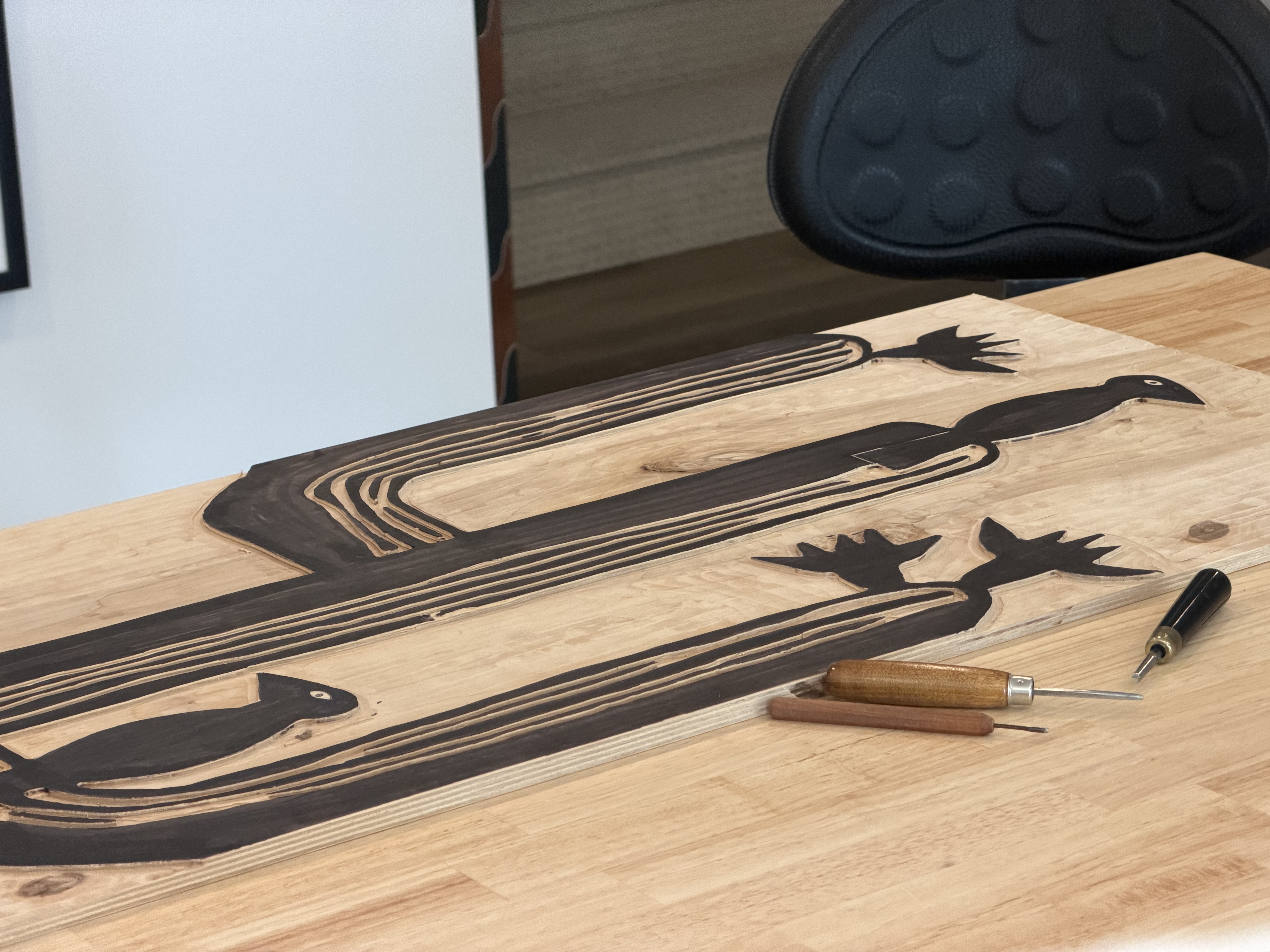
My block is an 18-by-60-inch sheet of half-inch Baltic birch and will be the largest print I’ve ever attempted. The design became a desert scene of towering cacti, desert plants, and a few birds that appear to have claimed the best perches. As with any relief print, the areas left standing will receive the ink, while everything carved away will remain unprinted.
Because of the block’s size, I used a router to remove much of the wood. The router made the larger areas go more quickly—although the timelapse makes the entire job look considerably faster than it actually was.
I then turned to hand tools, using gouges to refine edges, carve smaller areas, and add the lines and details that give the image its character.
The carving is now complete, but the plate is not quite ready to print. The next step is to apply shellac, which will seal the wood and prepare the surface for ink.
For now, I know what the plate looks like. What I don’t know is exactly how all those carved marks will come together once the block is inked, rolled over, and the fabric is lifted. That uncertainty—and the reveal at the end—is one of the things I love about printmaking.
I’ll share the results after the steamroller has done its part.
The event is open to the public and scheduled for 10:00 a.m.–3:00 p.m. in the KIA’s South Street parking lot.